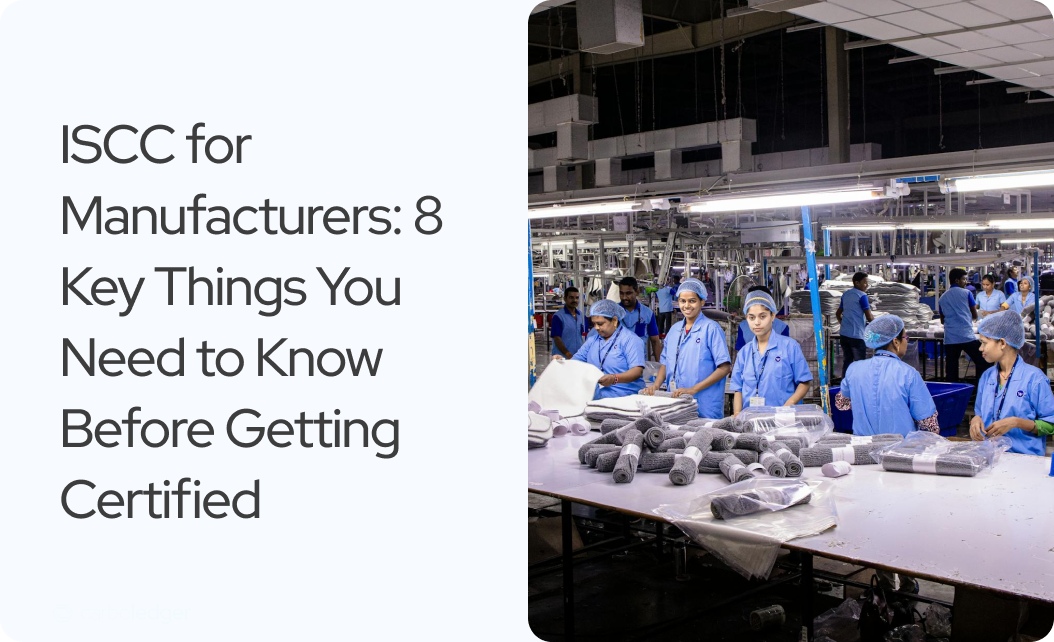
ISCC for Manufacturers: 8 Key Things You Need to Know Before Getting Certified
Key takeaways
- ISCC certification helps manufacturers prove sustainability and traceability of bio-based, recycled, and circular materials across global supply chains.
- Choosing between ISCC EU and ISCC PLUS depends on your product type, not location—EU for regulatory fuels, PLUS for broader industries.
- Mass balance is the most common model, requiring strong internal tracking and accurate documentation.
- GHG calculations and audit preparation are critical, with common failures linked to poor data, supplier gaps, and weak internal training
. - Digital tools can simplify compliance, reduce audit risks, and help manufacturers stay efficient and audit-ready long-term.
If you are a manufacturer looking to prove the sustainability of your products, ISCC for manufacturers is one of the most widely used certification systems for bio-based and circular supply chains. Whether you operate in the US, Canada, or Europe, ISCC (International Sustainability and Carbon Certification) helps you demonstrate that your materials and processes meet global sustainability standards.
From biofuels to bio-based chemicals and circular materials, increasingly expect ISCC certification or equivalent proof of sustainability. This guide breaks down everything manufacturers need to know, from what the certification covers to how to get started, avoid common mistakes, and stay compliant long-term.
What manufacturers must know about ISCC certification
1. What ISCC certification actually covers for manufacturers
ISCC for manufacturers is a globally recognized sustainability certification that validates the origin, traceability, and sustainability of biomass, bio-based, and circular materials throughout the supply chain. It was developed to support the EU Renewable Energy Directive (RED) and has since grown into a broader framework used across multiple industries.
For manufacturers, it means your raw materials, production processes, and outputs are audited against defined criteria, including greenhouse gas (GHG) savings, land use requirements, and chain of custody documentation.
- Covers biomass, bio-based feedstocks, recycled materials, and circular inputs
- Recognized under EU RED II and corporate sustainability frameworks
- Applies to manufacturers, processors, traders, and first collectors
2. ISCC PLUS vs ISCC EU, which certification suits your manufacturing operation
There are two primary ISCC schemes relevant to manufacturers: ISCC EU and ISCC PLUS. ISCC EU is specifically designed to meet the requirements of the EU Renewable Energy Directive and is used when biofuels and bioliquids need regulatory compliance in European markets. ISCC PLUS is a voluntary scheme that applies to a broader range of bio-based and circular economy products not covered under RED.
For manufacturers outside of energy and fuel, such as those producing bio-based plastics, chemicals, food packaging, or textiles, ISCC PLUS is generally the more applicable route.
- ISCC EU: used for compliance with EU Renewable Energy Directive requirements
- ISCC PLUS: voluntary, broader, suited for bio-based and circular manufacturers
- Both schemes require third-party audits and annual recertification
3. The chain of custody model that underpins ISCC for manufacturers
A core component of ISCC manufacturer certification is demonstrating chain of custody, the ability to track and document sustainable materials as they move through your production system. ISCC supports three chain of custody models: Identity Preserved, Segregation, and Mass Balance.
Most manufacturers use the Mass Balance approach, which allows sustainable inputs to be mixed with conventional ones in a shared system, with the certified volume tracked and allocated through bookkeeping. This is especially practical for large-scale manufacturers who cannot physically separate sustainable and non-sustainable feedstocks.
- Mass Balance is the most flexible and widely used model in manufacturing
- Requires robust internal tracking systems and documented record-keeping
- Must be consistently applied across all certified supply chain volumes
Choosing between ISCC EU and ISCC PLUS is not about geography. It depends on whether your product is regulated under RED or driven by voluntary market demand.
4. Step-by-step process to get ISCC manufacturer certification
Getting ISCC certification as a manufacturer involves a structured process. First, you determine which ISCC scheme applies to your business and which certification body (CB) is accredited in your region. Next, you prepare your internal documentation, covering sustainability criteria, GHG calculations, land use assessments, and supply chain records. Then a certified auditor conducts an on-site inspection.
Once the audit is passed, you receive your ISCC certificate, which is valid for one year and must be renewed annually. The process typically takes two to six months depending on your documentation readiness.
- Choose your scheme (ISCC EU or ISCC PLUS) and find an accredited CB
- Prepare sustainability documentation and internal data systems
- Pass the third-party audit and maintain records for annual renewal
5. GHG calculation requirements manufacturers often underestimate
One of the most technically demanding parts of ISCC for manufacturers is the greenhouse gas (GHG) emissions calculation. Under ISCC EU, certified products must demonstrate a minimum GHG saving compared to a fossil fuel comparator, currently set at typically 65% for new installations under EU RED II. GHG accounting is increasingly expected under ISCC PLUS, particularly for customers with Scope 3 reporting requirements.
Manufacturers need to calculate emissions across extraction, land use change, processing, transport, and distribution. Using default values provided by the European Commission can simplify this, but actual values must be used when processing contributes significantly to total emissions.
- GHG savings threshold: 65% for facilities installed after 2021
- Emissions must be tracked across the full supply chain lifecycle
- Default EU values can be used where individual data is unavailable
6 How ISCC certification opens doors in US, Canadian, and European markets
ISCC manufacturer certification carries significant commercial weight, particularly in EU-facing and export-driven supply chains. In Europe, it is required for compliance with the Renewable Energy Directive and aligns with Corporate Sustainability Reporting Directive (CSRD) expectations. In the US and Canada, large buyers in CPG, automotive, packaging, and chemicals are increasingly increasingly requiring ISCC certification or equivalent sustainability documentation from their suppliers as part of Scope 3 emissions reduction commitments.
Being ISCC certified signals to buyers and regulators alike that your manufacturing process has been independently verified for sustainability, which is becoming a competitive differentiator, not just a compliance checkbox.
- EU: required for RED compliance and increasingly for CSRD alignment
- US and Canada: growing buyer mandates across CPG, chemicals, and packaging
- Globally recognized, accepted in 100+ countries by major brands and regulators
7 Common compliance mistakes manufacturers make during ISCC audits
Many manufacturers approach their first ISCC audit underprepared in specific areas. The most common issues include incomplete or inconsistent sustainability declarations from suppliers, gaps in the mass balance bookkeeping system, insufficient GHG documentation, and failure to demonstrate a direct link between certified inputs and outgoing certified product volumes.
Auditors also frequently flag poor internal training — where operational staff do not understand the certification requirements they are responsible for maintaining. Preparation and internal alignment are critical well before the audit date.
- Incomplete upstream supplier sustainability declarations cause frequent failures
- Mass balance records must be reconcilable — gaps lead to non-conformances
- Internal staff must be trained on ISCC requirements before the audit
8 Digital tools and platforms that simplify ISCC manufacturer certification management
Managing ISCC manufacturer certification manually, through spreadsheets and email chains, creates risk and inefficiency. Modern digital platforms are designed to automate mass balance tracking, GHG calculation, certificate management, and sustainability data collection from across the supply chain.
These tools reduce audit preparation time, lower the risk of non-conformances, and give manufacturers real-time visibility into their certified volumes and documentation status. As ISCC certification requirements grow more rigorous, digital infrastructure is increasingly necessary for mid-to-large manufacturers managing complex supply chains.
- Automates mass balance bookkeeping and certified volume tracking
- Streamlines GHG data collection from suppliers
- Centralises certificate management and audit-ready documentation
ISCC EU vs ISCC PLUS, a quick comparison for manufacturers
Choosing the right scheme is the first decision manufacturers must make. Here is a side-by-side overview to clarify the key differences.
| ISCC EU | ISCC PLUS |
| Scope Biofuels and bioliquids for energy use under EU RED II | Scope Bio-based chemicals, plastics, textiles, food, packaging, and circular materials |
| Mandatory or voluntary? Mandatory for EU renewable fuel compliance | Mandatory or voluntary? Voluntary,growing buyer mandates globally |
| Best for Fuel manufacturers and energy producers supplying Europe | Best for Manufacturers in CPG, chemicals, packaging, and agriculture |
| Audit frequency Annual third-party audit required | Audit frequency Annual third-party audit required |
Tips for manufacturers preparing for ISCC certification
✓ Start supplier documentation requests at least three months before your audit date
✓ Choose a mass balance model that fits your operational structure, avoid unnecessary complexity
✓ Use the ISCC HUB system database to verify supplier certificates before accepting deliveries
✓ Train procurement, operations, and sustainability teams together, not in isolation
✓ Invest in digital tracking tools early to avoid data gaps that emerge under audit scrutiny
✓ Review GHG calculations with an independent expert before submission to avoid costly revisions
Conclusion
ISCC for manufacturers is more than a compliance exercise. It is increasingly a strategic tool that opens markets, satisfies buyer demands, and strengthens your sustainability credentials across the US, Canada, and Europe. From choosing between ISCC EU and ISCC PLUS, to managing mass balance records and passing annual audits, the process requires preparation, internal alignment, and reliable data systems.
If you are looking to simplify your ISCC manufacturer certification journey, platforms like Carboledger are built specifically to help manufacturers manage sustainability data, automate mass balance tracking, and stay audit-ready, all in one place. The sooner you start, the stronger your position will be in an increasingly sustainability-driven supply chain.
Frequently Asked Questions About ISCC for Manufacturers
What is ISCC certification for manufacturers?
ISCC (International Sustainability and Carbon Certification) is a globally recognized sustainability certification for manufacturers handling biomass, bio-based, or circular materials. It verifies that your inputs, production processes, and outputs meet defined sustainability and traceability standards, and is widely recognized across global supply chains, particularly in Europe and export-oriented markets.
How long does it take to get ISCC manufacturer certification?
The ISCC manufacturer certification process typically takes two to six months from the start of preparation to receiving your certificate. The timeline depends on how quickly you can gather supplier documentation, prepare your GHG calculations, and schedule a third-party audit with an accredited certification body.
Do manufacturers in the US and Canada need ISCC certification?
ISCC is not legally mandated in the US or Canada the way it is under the EU Renewable Energy Directive. However, major buyers in sectors like packaging, chemicals, and consumer goods increasingly require ISCC certification from suppliers as part of their own sustainability and Scope 3 reporting commitments, making it commercially essential.
What is mass balance in ISCC certification for manufacturers?
Mass balance is a chain of custody model used in ISCC certification that allows certified and non-certified materials to be mixed in a shared system, with certified volumes tracked through bookkeeping rather than physical separation. It is the most practical and widely used approach for manufacturers who cannot segregate feedstocks during production.
How much does ISCC manufacturer certification cost?
The cost of ISCC manufacturer certification varies based on company size, scheme (EU or PLUS), and the certification body selected. Typical costs include audit fees (often € 8,500–€ 10,000+), ISCC system fees, and internal preparation costs. Annual renewal audits are also required to maintain certified status.
Disclaimer:
Carboledger Inc. is an independent software provider. References to ISCC or any other certification schemes in this article are made solely for informational and educational purposes. Carboledger is not affiliated with, certified by, or endorsed by ISCC System GmbH or any certification body. The content does not constitute certification advice or official guidance.