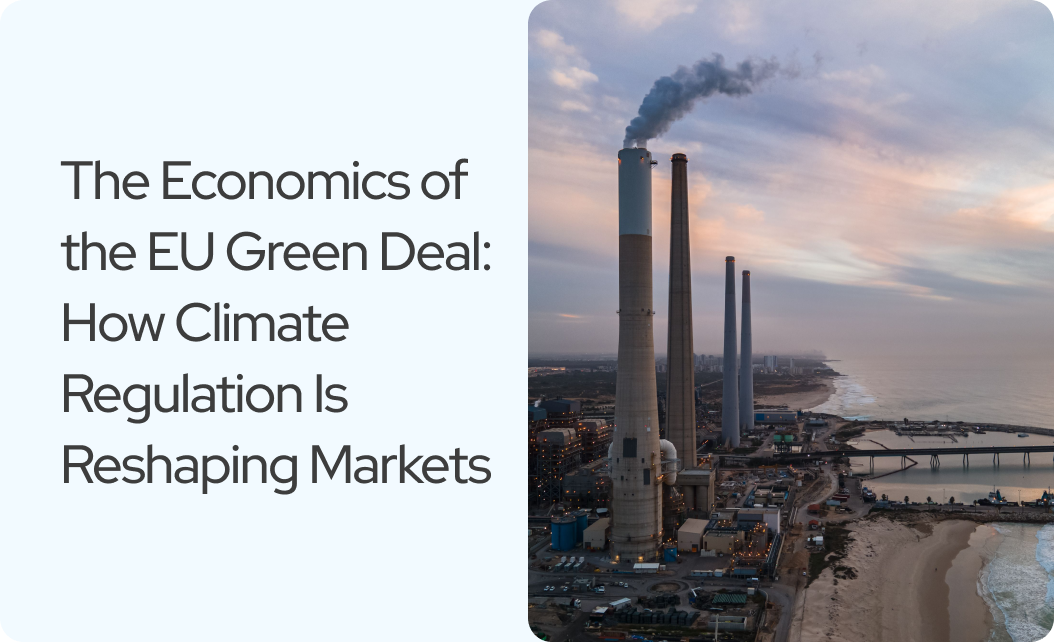
The Economics of the EU Green Deal: How Climate Regulation Is Reshaping Markets
For reasons always unknown to me, my workout jam these days is an economics podcast. The hosts talk about everything economics, but their favourite topic is regulations. Deregulation is, of course, the dream. Naturally, the availability heuristic has kicked in and I have started seeing everything through an economic lens. And when the real world collided with my latest mental strangulations, this blog series happened.
A friend I have known for most of the years since I started Carboledger suggested we catch up. We started talking about where sustainability was heading and he invariably asked me what I thought. I didn’t have a particularly clear answer, but I told him about a shift I have been observing. Sustainability seems to be moving, slowly but quite meaningfully, from reporting being the centre of everything towards regulations that have much more direct consequences for markets and businesses. His own experience seemed to corroborate this. His sustainability responsibilities are now much more intertwined with the CMO and the finance officer.
Ten years ago, sustainability getting cosy with marketing would probably have set off all my greenwashing alarms. Today, I am rather happy about it. The questions are finally becoming more interesting than what needs to be measured, disclosed and put into a report. Companies are asking what all of this means for their actual business. Can they retain market share, or increase it? Can a lower-carbon product earn a premium? Will customers eventually require it? Will regulation create that demand even if customers don’t voluntarily want to pay the premium today?
This is, of course, not a neat transition. My friend and I also spent a good part of the conversation discussing CSRD. His company had invested in preparing for it and then had to give management a full-blown explanation of why they had spent money on something that subsequently got significantly diluted. I would still argue that preparing was the prudent decision at the time. If the perceived risk was losing customers or market access, that downside was potentially much larger than the money spent preparing for CSRD. It is very easy to price a decision with information available in retrospect; businesses unfortunately have to make decisions before that information exists. I am happy that some of the reporting burden has been reduced, but I don’t think companies were foolish to prepare for it.
The CSRD experience did leave me with a question though. If reporting is itself a regulatory cost, what exactly are we getting in return for that cost? And more broadly, if companies are going to spend this much money and human effort responding to sustainability regulations, perhaps it is worth understanding what economic behaviour those regulations are trying to create in the first place.
Reading the EU Green Deal from the other end
Like most people working in this space, I usually encounter a regulation from the compliance end. What does it require a company to do? Which material qualifies? What GHG methodology applies? What evidence needs to be maintained? What needs to be reported and what does the auditor need to see? This time I wanted to go one step backwards and ask why the regulation exists at all, not merely from a climate perspective but from an economic one.
Once I started reading the EU Green Deal that way, the alphabet soup became considerably more interesting. The European Green Deal was introduced in 2019 not simply as an environmental programme, but as Europe’s new growth strategy. That wording matters because Europe was trying to solve several problems at the same time.
The obvious one was emissions. Europe had committed itself to a massive reduction in greenhouse gas emissions and ultimately to climate neutrality, while its economy was still substantially built on fossil energy. Oil moved transport, natural gas heated buildings and powered industry, coal and gas produced electricity and industrial heat, and oil and gas were also raw materials for enormous chemical and manufacturing value chains.
Much of that fossil energy was imported, which meant that decarbonisation also had implications for energy dependence. At the same time, Europe was home to industries such as steel, chemicals, cement, refining and automotive manufacturing that compete in global markets. Make producing something in Europe dramatically more expensive and there is always the rather inconvenient possibility that somebody will simply produce it somewhere else. Europe could then congratulate itself for lowering domestic emissions while continuing to consume the same products manufactured abroad.
Seen this way, the problem Europe had given itself wasn’t merely how to reduce carbon emissions. It was how to remove fossil carbon from the physical foundation of a modern economy without making Europeans materially poorer, losing European industry or simply moving the emissions somewhere else. That is a considerably harder economic problem, and once you see it that way, many of the seemingly disconnected pieces of EU climate regulation start fitting together.
The alphabet soup starts making some economic sense
Take the EU Emissions Trading System. If emitting carbon creates a cost for society but that cost isn’t reflected in the price paid by the emitter, economics gives us a fairly elegant answer: put a price on carbon. The EU ETS does essentially that through a cap-and-trade market, creating scarcity around the right to emit and allowing the market to determine the price.
That immediately creates another problem. Imagine a European steel producer paying that carbon price while a foreign steel producer selling into Europe doesn’t face an equivalent cost. European production becomes less competitive and, in the worst case, production simply moves abroad without doing very much for the atmosphere. This is where CBAM starts making economic sense. It isn’t an entirely separate climate idea; it follows from a problem created by having a carbon price in an economy that trades with countries that may not have the same one.
Renewable energy introduces a different intervention. Perhaps making fossil energy more expensive still doesn’t make renewables grow as quickly as Europe wants. RED, and subsequently RED II and RED III, don’t simply wait for the carbon price to do the work. They require renewable energy to occupy a growing share of the system.
Aviation goes one step further. If renewable fuels are scarce and expensive, a market left to optimise for today’s economics might use those fuels in sectors where they can reduce emissions more cheaply. Aviation could therefore continue using fossil jet fuel while easier sectors decarbonise first. ReFuelEU Aviation deliberately interferes with that outcome by requiring an increasing share of Sustainable Aviation Fuel. Europe is effectively creating demand for SAF before airlines would necessarily have created the same demand voluntarily.
Then there are regulations attacking completely different parts of the problem. CSRD works on the premise that investors, customers and management need better sustainability information to make decisions. The Digital Product Passport takes information closer to the product itself. The Net-Zero Industry Act starts asking whether Europe can manufacture enough of the technologies required for its own transition, while the Critical Raw Materials Act deals with the uncomfortable possibility that dependence on imported fossil fuels could simply become dependence on imported lithium, rare earths and other critical materials.
These regulations are doing very different things, but they aren’t random. One puts a price on something that was previously insufficiently priced. Another changes the economics of imports. Another mandates demand. Another creates information. Another supports domestic supply, while another worries about the raw materials behind that supply. Put together, the EU Green Deal starts looking less like a giant sustainability programme and more like an attempt to change the incentives running through an economy.
And this is where I started having trouble with it.
If carbon pricing works, why do we need everything else?
The economist’s version of climate policy can sound wonderfully simple. Carbon emissions create an externality, so put an appropriate price on that externality and let businesses and consumers figure out how best to respond. If renewable electricity is the cheapest solution, build renewable electricity. If nuclear is cheaper, build nuclear. If a steel producer finds hydrogen economical, use hydrogen. If another technology can remove the same carbon more cheaply, use that instead. The regulator doesn’t need to know the answer because discovering those answers is precisely one of the things markets are rather good at.
Except that isn’t the system Europe has built. Europe prices carbon through the ETS, but it also mandates renewable energy, creates specific demand for SAF, supports renewable hydrogen, regulates vehicle emissions, funds infrastructure, subsidises technologies, regulates products and supports European manufacturing capacity. Somewhere along the way, we have moved from correcting a market failure to constraining the market, creating markets that don’t yet exist at scale and, in some cases, actively deciding where the market should go.
That doesn’t automatically make these interventions wrong. A market may not build a hydrogen pipeline when there are no hydrogen producers, while producers may not build plants when there is no pipeline, and nobody wants to build either when there are no committed buyers. A company may not finance the first commercial SAF plant if it has no idea whether airlines will buy expensive SAF ten years from now. A new technology may generate knowledge that benefits an entire industry while the company taking the initial risk captures only a fraction of that value. Europe may also simply decide that waiting for markets to discover the solution in 2045 is not particularly useful when it has a legally binding climate timetable.
There are therefore perfectly legitimate economic reasons to intervene. But there is also a line worth examining between correcting something the market cannot solve and replacing something the market is actually very good at doing. I suspect much of what is interesting about the EU Green Deal sits somewhere around that line.
Regulation doesn’t only create costs. It can create value.
This is perhaps the part I find most interesting as someone sitting inside this world. Take used cooking oil. On its own, UCO is a waste material with certain physical uses and a market price. Once regulation decides that fuels made from particular waste feedstocks receive favourable treatment towards renewable-fuel obligations, however, the regulatory identity of that material acquires economic value.
Suddenly, it matters whether something really is used cooking oil, where it came from, what its GHG intensity is, whether it meets the relevant sustainability criteria and whether the chain of custody behind the claim is credible. Once those characteristics have money attached to them, someone has to prove that they are real. That is how we end up with sustainability declarations, certification schemes, mass balance, GHG calculations, audits, databases and increasingly elaborate traceability systems.
Some of this evidence is absolutely necessary. If calling my fuel sustainable makes it worth considerably more money, I cannot simply be allowed to print that on an invoice and call it a day. But there is another economic question hiding underneath the first one: how much should it cost to prove that the claim is real?
If a company needs ten people moving information between spreadsheets to establish something that could have been captured when the underlying transaction happened, that isn’t necessarily valuable compliance. It may simply be an expensive way of producing evidence. I work in regulatory technology, so this question is particularly close to home, but I have no interest in arguing that companies should spend more time on compliance simply because compliance creates a market for technology companies. The more interesting question for technology is how much of this work can disappear altogether.
There will always be work that genuinely requires human judgement, just as there will be evidence that genuinely needs to exist. But generating that evidence should increasingly become a by-product of normal business operations rather than a separate industry of people reconstructing what happened three months later. If regulation is going to change markets, I would much rather have people spending their time understanding those changes, deciding what to buy, where to invest and what risks to take than copying numbers between systems.
The business question underneath the compliance question
For a company, saying that regulation is a cost is therefore correct but incomplete. A carbon price is a cost to somebody and an advantage to somebody else. A renewable-fuel mandate creates a compliance cost for the obligated buyer but demand for the producer. CBAM changes the relative economics of domestic and imported products. A SAF mandate can make a fuel commercially valuable even while it remains more expensive than fossil jet fuel. A recycled-content requirement can turn somebody else’s waste stream into somebody’s valuable feedstock.
Regulation changes relative prices, demand, risk and investment. It creates bottlenecks and, sometimes, markets that would not have existed in the same form without it. For a business, the more useful question may therefore not be only how much a regulation is going to cost, but what the regulation is trying to make economically valuable and where the business sits when that happens.
That is the rabbit hole I want to go down in this series. Not regulation by regulation, and definitely not another collection of “five things you need to know about CBAM” articles. There are enough of those and I will continue bookmarking them because, well, bread and butter. I want to start with the economic problem, understand what Europe did about it and then follow what happened to the market.
I suspect that sometimes we will conclude that regulation corrected something the market couldn’t solve on its own. In other cases, Europe may be deliberately accepting a more expensive outcome today because it wants a different market tomorrow. And there will probably be places where we discover that we have created a tremendous amount of administrative work without being entirely sure that the economic value produced justifies it.
I don’t yet know where I will land on all of it, which is partly the point of writing the series. But the obvious place to start is with the simplest version of the theory: if carbon is the problem, why not just make carbon expensive and let the market figure out everything else? That takes us to the EU ETS.