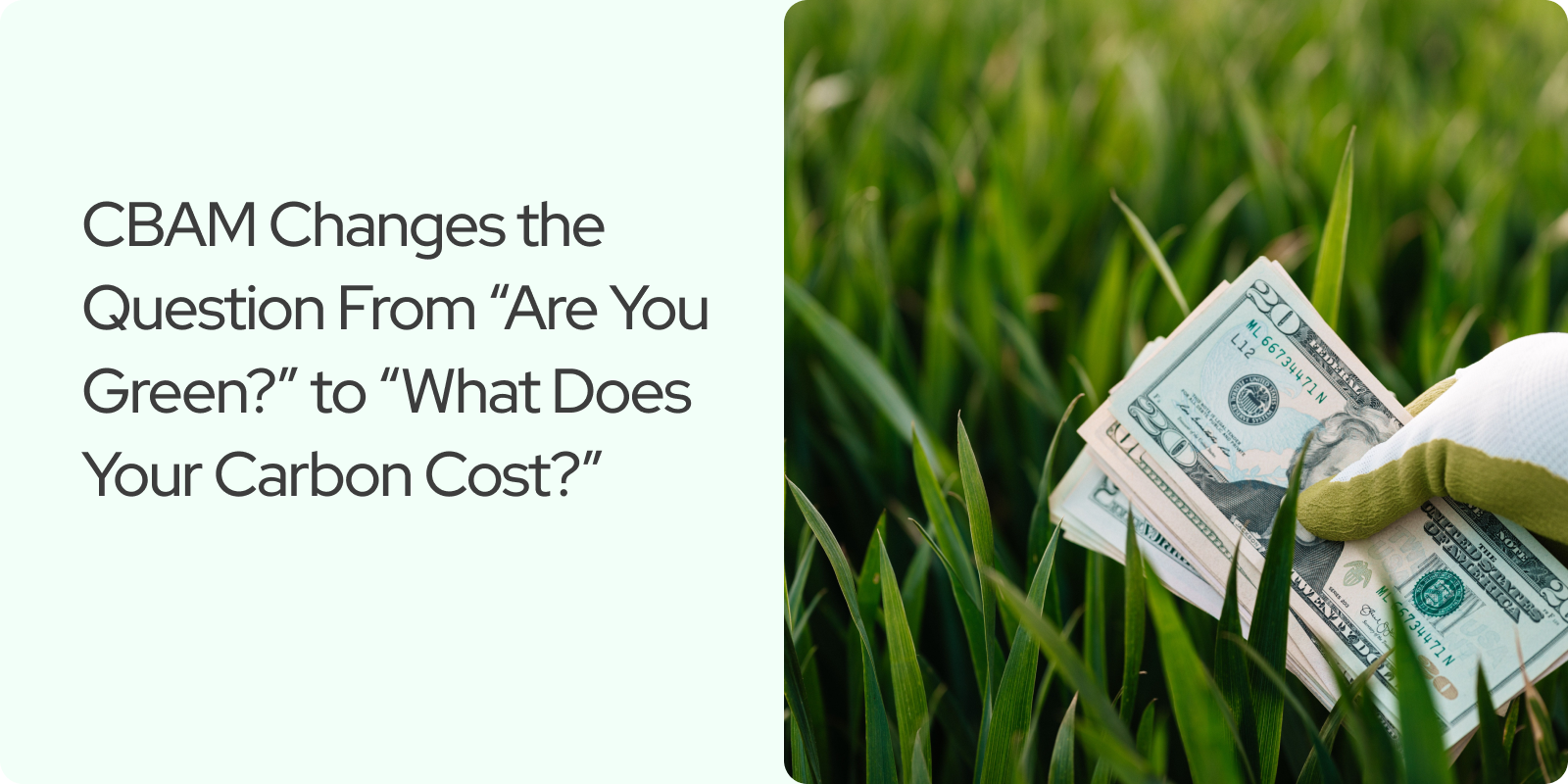
CBAM Changes the Question From “Are You Green?” to “What Does Your Carbon Cost?”
Key Takeaways
- CBAM puts a cost on embedded carbon: Since 2026, carbon emissions from covered imports have become a financial consideration linked to EU carbon prices.
- Low-carbon products can gain a competitive advantage: Lower embedded emissions can improve a product’s effective cost compared with higher-carbon alternatives.
- Carbon data influences procurement decisions: Accurate, comparable and verified emissions data can affect supplier selection and commercial value.
- CBAM creates strategic opportunities for exporters: Investing in cleaner production can help businesses strengthen their competitiveness in the EU market.
- Compliance is only part of the picture: Businesses should understand how CBAM affects costs, pricing, investment and market positioning, not just reporting obligations.
For a long time, corporate carbon accounting had a slightly peculiar relationship with economics. Companies spent enormous amounts of time calculating emissions, publishing them in sustainability reports and setting reduction targets, but the number itself often sat some distance away from the commercial transaction. A procurement manager buying a tonne of steel still primarily cared about its specification, price, supplier, delivery date and quality. The fact that one tonne might have substantially higher embedded emissions than another was interesting to the sustainability team, but it did not necessarily change what the procurement team paid.
CBAM makes that separation much harder to maintain.
Since 1 January 2026, the EU Carbon Border Adjustment Mechanism has been operating in its definitive regime. It currently covers selected goods in cement, iron and steel, aluminium, fertilisers, electricity and hydrogen. For imports within scope, embedded carbon is no longer merely a number that somebody eventually puts into an emissions inventory. It contributes to a financial obligation linked to the EU carbon price.
That sounds like a relatively small change in accounting. Economically, it is quite a large one.
Because once carbon changes the effective cost of a product, the sustainability characteristics of that product start entering the same conversation as price.
CBAM exists because the EU ETS creates an awkward problem
The logic starts with the EU ETS.
As I discussed earlier in this series, Europe has deliberately made the right to emit carbon scarce. Companies in covered sectors have to surrender allowances for their emissions, and those allowances have a market price. That gives European industrial producers a financial reason to reduce emissions.
But there is an obvious problem if Europe does this while the rest of the world doesn’t impose an equivalent carbon constraint.
Imagine a European steel producer and a foreign steel producer making essentially comparable products. The European producer faces a carbon cost associated with its production while the foreign producer does not. If that difference makes imported steel cheaper, European buyers can simply purchase more of the foreign product.
Europe has then achieved a rather unimpressive result. The emissions have not necessarily disappeared. Some production has simply moved outside the jurisdiction imposing the carbon cost.
This is the carbon-leakage problem.
For years, Europe partly dealt with it through free allocation under the EU ETS. Industries exposed to international competition received some allowances without paying the auction price for them, reducing the immediate financial disadvantage relative to foreign producers.
That solution has an obvious weakness. The more generously you protect European industry from the carbon price, the less strongly the carbon price influences its behaviour.
Europe therefore needs to accomplish two things that pull in opposite directions. It wants European industrial producers to feel a progressively stronger incentive to decarbonise, while also preventing that carbon cost from simply making imported high-carbon products more attractive.
CBAM is the attempt to square that circle.
Put a comparable carbon constraint at the border
The basic economic idea is remarkably intuitive. If an EU producer has to bear a carbon cost associated with making a tonne of steel, an imported tonne of steel should not escape an equivalent constraint simply because its emissions occurred somewhere else.
CBAM therefore creates a financial adjustment associated with the embedded emissions of covered imported products. Its certificate price is linked to the EU ETS allowance price, while the mechanism also accounts for factors including the gradual adjustment associated with EU ETS free allocation and, where applicable, carbon prices already paid in the country of production.
The phase-in matters. CBAM is not simply imposing the full EU carbon cost on every imported tonne overnight. Its financial adjustment increases as free allocation for corresponding EU production is phased down, with the architecture intended to become fully effective as that protection disappears.
This is a useful reminder that CBAM and the EU ETS are not really separate pieces of climate policy. They are two sides of the same market design.
ETS asks European producers to internalise more of the cost of carbon. CBAM tries to prevent imports from avoiding the economic consequence of that decision.
And this is where something interesting happens to international trade.
Imagine two steel suppliers
Suppose a European importer can buy the same grade of steel from Supplier A or Supplier B.
Supplier A charges €700 per tonne and produces the steel with embedded emissions of 2 tonnes of CO₂ per tonne of steel. Supplier B has invested in cleaner production and charges €760 per tonne, but its embedded emissions are only 0.8 tonnes.
Without a carbon cost, procurement has a fairly obvious reason to prefer Supplier A. It is €60 cheaper.
Now imagine, purely for illustration, that the applicable carbon cost were €75 per tonne of CO₂ and that we ignored the various CBAM adjustments for the moment. Supplier A’s two tonnes of embedded emissions would represent €150 of carbon exposure, while Supplier B’s 0.8 tonnes would represent €60.
The effective comparison begins to look very different.
Supplier A:
€700 product + €150 carbon = €850
Supplier B:
€760 product + €60 carbon = €820
The cleaner supplier can charge €60 more for the physical steel and still produce the better overall economic outcome for the importer.
The actual CBAM calculation is more complicated than this deliberately simplified example, particularly during the phase-in. But the economic point is the important part: carbon intensity can change supplier competitiveness.
That is a much stronger mechanism than asking suppliers whether they have a net-zero target.
Carbon accounting suddenly becomes procurement information
This is one of the reasons I think CBAM is more consequential than another sustainability reporting requirement.
Imagine the same procurement manager from a few years ago receiving two quotes for steel. The sustainability team might have preferred the lower-carbon supplier, but procurement still had to explain why the business should pay an additional €60 per tonne. Unless the company had a meaningful internal carbon price, customer requirement or voluntary climate commitment strong enough to influence purchasing, the cleaner product was simply more expensive.
CBAM begins changing that calculation.
The procurement team now has a reason to ask about embedded emissions because the answer can affect the economics of the purchase. The finance team has a reason to care because carbon creates a liability. The sustainability team has information that can influence supplier selection rather than merely describe it afterwards.
More interestingly, the supplier has a reason to reduce its carbon intensity even if it is sitting thousands of kilometres away from Europe.
That is precisely what the policy is trying to achieve. The EU cannot directly place a European carbon price on a steel mill in India, China or Brazil. But it can change the conditions under which the mill’s product enters the European market.
The carbon price has effectively travelled through the trade relationship.
This creates a strange new export characteristic
For exporters into Europe, carbon intensity begins to look like another product characteristic.
A steel manufacturer already thinks about grade, strength, dimensions, quality and price. An aluminium producer thinks about purity and specification. A fertiliser producer thinks about nutrient content and formulation. These characteristics influence which customers can buy the product and what they are willing to pay.
Embedded emissions can now join that list.
This doesn’t mean every low-carbon producer will automatically receive a premium. Markets are not usually that generous. If several suppliers can provide lower-carbon material, buyers will happily force them to compete away as much of the advantage as possible.
But a high-carbon producer can increasingly find itself carrying a disadvantage that has nothing to do with the physical performance of its product.
This is exactly the distinction I was trying to make when I wrote that a tonne isn’t just a tonne anymore. Two physically comparable products can have different economics because an environmental characteristic has acquired regulatory value.
CBAM simply makes the value unusually visible because we can begin expressing it in euros.
Then comes the awkward question: whose carbon number do we believe?
The moment a lower emissions number produces a financial advantage, the quality of the number becomes considerably more important.
Suppose Supplier A says its embedded emissions are 1.8 tonnes of CO₂ per tonne of product while Supplier B says 0.9. Before procurement changes suppliers or finance models the CBAM exposure, somebody needs to know whether those numbers are actually comparable.
Did both companies use the required methodology? What emissions were included? What production route was used? How were precursor emissions treated? Where did the electricity data come from? Has the information been verified?
This is why the definitive CBAM regime allows importers to use actual emissions data under prescribed rules, with verified actual data requiring involvement from accredited verifiers. Operators outside the EU therefore have to monitor and calculate embedded emissions in accordance with the CBAM methodology if their customers want to use those actual values.
Alternatively, the system provides default values.
That choice has interesting economics of its own. If my plant genuinely performs better than the relevant default, I have an incentive to measure and verify my actual emissions so that my customer can benefit from the difference. If my actual performance is worse, the incentives can obviously look rather different depending on the applicable rules and defaults.
Carbon accounting has therefore moved another step away from corporate reporting. The accuracy of the calculation can influence the commercial attractiveness of a particular supplier.
Suddenly, arguing about emission factors doesn’t feel quite so academic.
There is an even bigger strategic implication for exporters
Most discussions of CBAM understandably focus on compliance: who is in scope, which CN codes apply, how emissions should be calculated, when declarations are due and how certificates work.
Companies obviously need those answers. But if I were running an industrial business exporting significant quantities of covered goods into Europe, I would be asking another set of questions as well.
How carbon-intensive are we relative to our competitors? How much does that difference affect the effective cost of our product as CBAM phases in? Which production investments become economically sensible if carbon is included in the customer comparison? Could lower-carbon electricity improve our export position? Could a cleaner production route allow us to defend a higher selling price? Are there European customers for whom our emissions performance creates a particularly large advantage?
Those are commercial strategy questions.
The distinction matters because a company can become excellent at calculating its CBAM emissions while completely missing what CBAM is doing to its market.
Compliance tells you how to calculate the number. Strategy asks what the number does to your business.
Carbon pricing can change comparative advantage
There is a broader implication here that I suspect we will be watching for many years.
Countries have historically developed industrial advantages based on labour costs, energy prices, natural resources, infrastructure, logistics, technology and proximity to customers. Carbon intensity can now begin modifying those advantages for trade into a large market like Europe.
A region with abundant low-carbon electricity may become relatively more attractive for energy-intensive production. A plant that has access to lower-carbon feedstocks may gain an advantage over a competitor using a more emissions-intensive route. Industrial investments that previously looked uneconomic can start looking different when the alternative carries an increasing carbon cost.
This is one way climate regulation can influence the geography of industry without Europe explicitly telling companies where to build factories.
But there is also a geopolitical edge to it. Europe is effectively applying the economic consequences of its domestic carbon policy to imports entering its market. Trading partners may view that as climate policy, industrial policy, trade policy or some mixture of all three.
In practice, it probably is some mixture of all three.
CBAM also shows why simplification matters
There is a final piece of the mechanism that connects back to the previous blogs.
Europe originally created a system under which a very large number of importers could potentially face CBAM administrative requirements, including many companies importing relatively small quantities. The rules have since been simplified through a 50-tonne annual mass threshold for most covered goods. The Commission estimated that this would remove around 90% of importers from CBAM obligations while retaining more than 99% of the emissions originally in scope.
I find that ratio fascinating.
If you can eliminate compliance obligations for roughly nine out of ten affected importers while preserving more than 99% of the emissions coverage, you have probably found a fairly good example of administrative effort that wasn’t proportionate to environmental impact.
It also reinforces the argument from the previous blog. Environmental integrity and administrative complexity are not the same thing. Sometimes you can reduce one dramatically without meaningfully weakening the other.
Good regulation should be actively searching for those opportunities.
The carbon number has escaped the sustainability report
This is ultimately why I think CBAM deserves attention well beyond the teams directly responsible for filing declarations.
For years, sustainability professionals have argued that carbon should influence business decisions. CBAM doesn’t ask companies to agree with that proposition. For covered trade, it begins putting the mechanism into the economics of the transaction itself.
A procurement manager can compare suppliers differently. An exporter can think about carbon intensity as part of competitiveness. A CFO can see carbon appear in the cost structure of imports. An industrial company considering a cleaner production route can model not only the emissions saved but the future market position those savings might create.
None of this means that every company will immediately reorganise itself around carbon. The mechanism phases in gradually, carbon prices move, trade flows respond and companies will inevitably find ways to optimise around the rules.
But the direction is important.
The Green Deal started with a climate objective. The EU ETS converted part of that objective into a carbon price. CBAM takes that carbon price and carries it into international trade.
At each step, sustainability moves slightly closer to ordinary economics.
Which brings me to the final question in this series. If regulation is changing prices, creating scarcity, determining which products qualify for markets and altering the relative value of suppliers and assets, why are so many companies still treating regulatory sustainability almost entirely as a cost centre?
Perhaps the more useful question isn’t only what compliance is going to cost us.
It is what has regulation just made valuable?
That is where I want to end this series.