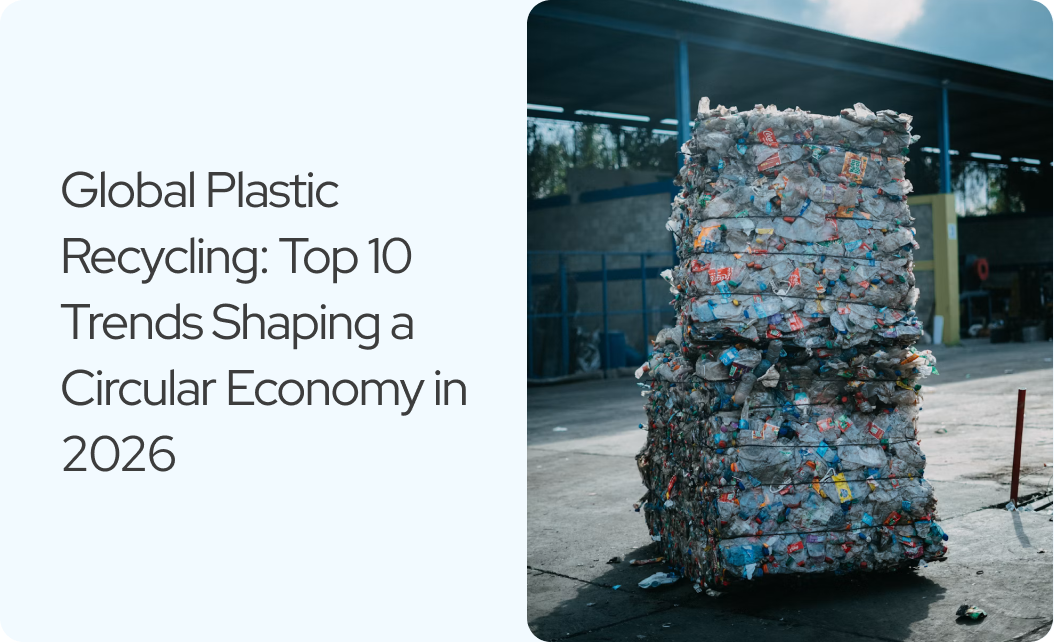
Global Plastic Recycling: Top 10 Trends Shaping a Circular Economy in 2026
Key Takeaways
- Chemical recycling and AI are improving plastic recycling efficiency.
- ISCC PLUS and traceability ensure verified recycled content.
- EPR laws are increasing demand for recycled materials.
- Carbon accounting is becoming part of recycling strategies.
- Sustainability and compliance are driving a circular economy.
Global plastic recycling is no longer just an environmental buzzword, it’s a measurable, investable, and regulated space that is reshaping industries worldwide. Every year, the world generates over 400 million metric tons of plastic waste, yet less than 10% is effectively recycled. For sustainability professionals, compliance teams, and ISCC-certified organizations operating in the US and globally, understanding where the recycling landscape is heading is not optional, it’s essential.
This article breaks down the top 10 trends driving global plastic recycling forward in 2026, with practical insights into what each means for businesses committed to circular economy goals and sustainable materials management.
Top 10 Global Plastic Recycling Trends in 2026
1. Chemical Recycling Is Scaling Up Fast
Chemical recycling refers to a range of technologies that convert plastic waste into feedstocks, monomers, or other chemical products that can be used to manufacture new materials. Many chemical recycling technologies can process certain mixed or contaminated plastic streams that are difficult to recycle mechanically, although feedstock requirements vary by technology.
In the US, companies such as ExxonMobil have announced significant investments and capacity expansions in advanced recycling technologies. For ISCC PLUS-certified supply chains, chemically recycled content can now be mass-balance-credited under certified frameworks, making it a viable pathway for brands with recycled content targets.
- Handles hard-to-recycle mixed plastics
- Can produce feedstocks for manufacturing virgin-equivalent polymers.
- Increasingly supported by ISCC PLUS certification
Chemical recycling is a cornerstone of the global plastic recycling strategy for 2026 and beyond.
2. ISCC PLUS Certification Adoption Continues to Grow
The International Sustainability and Carbon Certification (ISCC PLUS) framework has become one of the most recognized certification systems for recycled and bio-based plastics. It allows companies to use the mass balance approach to prove and communicate recycled content across complex supply chains.
US brands sourcing post-consumer recycled (PCR) content increasingly require ISCC PLUS from suppliers. This is especially relevant in sectors like packaging, textiles, and automotive components. ISCC PLUS provides traceability and transparency — two qualities that both regulators and consumers now demand.
- Recognized in the US, EU, and key Asian markets
- Enables mass balance accounting for mixed streams
- Supports supply chain traceability, recycled content claims, and sustainability reporting
3. Extended Producer Responsibility (EPR) Laws Are Expanding in the US
Extended Producer Responsibility (EPR) legislation requires manufacturers and brands to fund and manage the end-of-life of their plastic products. States like California, Oregon, Colorado, and Maine have already enacted EPR for packaging, with more states expected to follow in 2026.
These laws are a major driver of investment in global plastic recycling infrastructure. Brands facing EPR obligations are motivated to invest in certified recycled content, traceability platforms, and take-back systems. Organizations with strong traceability and material accounting systems may find it easier to support certain reporting requirements associated with EPR schemes.
- Shifts recycling costs from taxpayers to producers
- Creates financial incentives for recyclable packaging design
- Supports traceability and sustainability reporting across recycling supply chains
4. Advanced Sorting Technologies Are Improving Recycling Rates
One of the biggest bottlenecks in global plastic recycling has been contamination and poor sorting. AI-powered robotic sorters, near-infrared (NIR) spectroscopy, and digital watermarking are transforming material recovery facilities (MRFs) across the US.
These technologies can identify and separate plastics by resin type, color, and additive content at speeds and accuracy levels human sorters cannot match. The result is higher-quality recyclate that commands better prices and performs better in downstream applications.
- AI-driven sorting increases purity of recyclate
- Digital watermarks enable full lifecycle traceability
- Better input quality supports chemical recycling pathways
5. Recycled Content Mandates Are Entering Mainstream Policy
US policy is increasingly driving demand for recycled content through a combination of extended producer responsibility (EPR) laws, packaging regulations, and recycled-content requirements for specific product categories. California’s SB 54 focuses on reducing plastic packaging waste through producer responsibility and recyclable or compostable packaging requirements, while other laws, such as AB 793, establish recycled-content requirements for certain plastic beverage containers.
These mandates are forcing brands and material suppliers to secure verified recycled content at scale. Mass balance certification under ISCC PLUS is one approach that organizations use to verify recycled content in complex supply chains while maintaining traceability.
- Drives demand for certified recycled content
- Encourages long-term offtake agreements with recyclers
- Incentivizes investment in new recycling capacity
6. Digital Traceability Is Becoming a Core Capability Across Recycling Supply Chains
Transparency has become a core requirement across plastic recycling supply chains. Brands, regulators, investors, and certification schemes increasingly expect organizations to demonstrate where recycled materials originate, how they move through the supply chain, and how recycled content claims are substantiated.
As a result, organizations are investing in digital traceability platforms that connect supplier data, certification records, material movements, and sustainability information into a single source of truth. Rather than relying on disconnected spreadsheets and manual documentation, digital systems help organizations maintain consistent records, support mass balance accounting, and generate audit-ready evidence for customers and certification bodies.
- Centralizes supplier, certification, and material traceability data
- Supports mass balance accounting and recycled content verification
- Improves audit readiness and sustainability reporting
7. Flexible Packaging Recycling Is Finally Getting Attention
Flexible plastics, films, pouches and wrappers make up a significant share of global plastic waste but have historically been almost entirely excluded from recycling programs. In 2026, this is beginning to change.
Programs like How2Recycle’s Store Drop-Off initiative and new mechanical and chemical recycling lines specifically designed for polyethylene (PE) film are creating new recovery pathways. Brands using flexible packaging now have more options for incorporating certified recycled content and closing the loop on their packaging portfolios.
- Addresses a major unrecycled plastic waste stream
- New collection and processing infrastructure emerging in the US
- Supports brand-level recycled content commitments
8. The Global Plastics Treaty Is Reshaping International Norms
Negotiations for a global UN plastics treaty are underway, with the goal of creating the first legally binding international agreement to end plastic pollution. While negotiations are ongoing, discussions have focused on topics such as sustainable production and consumption, product design, waste management, financing, and measures to reduce plastic pollution. The final obligations remain under negotiation.
For US companies operating globally, the treaty will create new compliance expectations across markets. Organizations that already maintain strong traceability, recycled-content verification, and sustainability reporting processes are likely to be better positioned to adapt as the treaty evolves.
- Could establish a common international framework for addressing plastic pollution.
- May influence future regulatory and reporting requirements across international markets.
- Is expected to increase demand for verified recycled content and supply chain transparency.
9. Ocean and Post-Consumer Recycled (PCR) Plastic Is Gaining Premiums
Brands are increasingly differentiating themselves by incorporating ocean-bound or post-consumer recycled (PCR) plastic into their products. These materials carry a premium but provide significant brand value and meet the preferences of sustainability-conscious consumers and B2B buyers.
In the US, segments such as personal care, apparel, and consumer electronics are leading adoption. Third-party certification or verification is commonly used to substantiate recycled-content or ocean-bound plastic claims.
- High brand value and consumer communication potential
- Requires certified chain of custody for credible claims
- Supports biodiversity and coastal community co-benefits
10. Carbon Accounting Is Being Integrated Into Plastic Recycling Metrics
As corporate sustainability disclosures become more rigorous, global plastic recycling is increasingly being evaluated not just on tonnage but also on lifecycle greenhouse gas impacts. Companies are increasingly quantifying the lifecycle greenhouse gas impacts associated with using recycled rather than virgin plastic to support lifecycle assessments, internal decision-making, and sustainability reporting.
Platforms that help organizations manage material traceability, lifecycle emissions data, and sustainability reporting, aligned with standards and frameworks such as ISO 14040, ISO 14044, ISO 14067, the GHG Protocol, while incorporating certification data from systems such as ISCC, are becoming increasingly valuable for sustainability teams. This is where companies like Carboledger are playing a meaningful role, offering carbon accounting, traceability, and sustainability data infrastructure that integrates with material certification data to generate credible, audit-ready sustainability and emissions data.
- Links recycling KPIs to Scope 3 emissions reduction
- Increasingly supports reporting under frameworks such as CDP and the GHG Protocol
- Carboledger provides integrated carbon and ISCC-aligned traceability tools
Quick Comparison: Mechanical vs. Chemical Recycling
| Feature | Mechanical Recycling | Chemical Recycling |
| Input Material | Clean, sorted plastic | Mixed, contaminated plastic |
| Output Quality | Recycled polymer (quality depends on feedstock and process) | Feedstocks or recycled raw materials that may be used to manufacture virgin-equivalent polymers |
| Scale in US (2026) | Established | Rapidly expanding |
| ISCC Compatibility | Yes | Yes (mass balance) |
| Cost | Lower | Higher, falling |
| Best For | PET, HDPE bottles | Multi-layer films, PS, mixed waste |
Conclusion
Global plastic recycling is at a pivotal moment. From the rise of chemical recycling and advanced sorting to mandatory recycled content laws and the emerging global plastics treaty, the forces reshaping this industry are accelerating fast. For ISCC-certified organizations and sustainability professionals operating in the US, staying ahead of these trends is both a compliance necessity and a competitive opportunity.
Whether you are sourcing certified recycled content, managing product carbon data, reporting greenhouse gas emissions, or building traceability into your supply chain, Carboledger helps organizations connect material certification data with carbon accounting systems to generate credible, audit-ready sustainability metrics, purpose-built for the demands of the modern recycled plastics supply chain.
Take the next step: assess your current recycled content traceability and carbon accounting capabilities today.
Frequently Asked Questions
What is global plastic recycling, and why does it matter in 2026?
Global plastic recycling refers to the worldwide collection, processing, and reuse of plastic waste to recover materials and reduce environmental impact. In 2026, it matters because less than 10% of plastic is currently recycled globally, and new regulations, corporate commitments, and consumer expectations are all demanding rapid improvement.
How does ISCC PLUS support global plastic recycling supply chains?
ISCC PLUS is a certification framework that allows companies to use the mass balance method to verify and communicate recycled or bio-based content through complex supply chains. It is widely recognized in the US, EU, and globally, making it a key tool for brands sourcing certified recycled plastic.
What is the difference between mechanical and chemical recycling?
Mechanical recycling physically reprocesses clean, sorted plastic into pellets or flakes. Chemical recycling uses a range of processes to convert plastic waste into feedstocks, monomers, or other chemical products that can be used to manufacture new materials. Chemical recycling is growing rapidly in the US and can produce virgin-equivalent materials.
How do EPR laws impact US companies involved in plastic recycling?
Extended Producer Responsibility (EPR) laws require brands and manufacturers to fund and manage the recycling of their plastic packaging. States including California, Oregon, and Maine have active EPR programs. These laws create compliance obligations but also investment incentives for certified recycled content and better packaging design.
How is carbon accounting connected to plastic recycling?
Using recycled plastic instead of virgin material can reduce lifecycle greenhouse gas emissions compared with virgin plastic, depending on the material, recycling process, and system boundaries used in the assessment. Carbon accounting platforms can quantify lifecycle greenhouse gas emissions associated with recycled materials and support reporting under frameworks such as the GHG Protocol and CDP. Integrating carbon metrics with recycling data is increasingly expected in corporate sustainability disclosures.